
Most first fragrance launches do not fail because of the scent. They fail because nobody can prove what happened. Batch records are the part of the project nobody photographs and everybody needs the first time a customer complains, a retailer asks a question, or a batch has to be traced. On an influencer drop, where demand arrives faster than a replacement order, that gap is expensive.
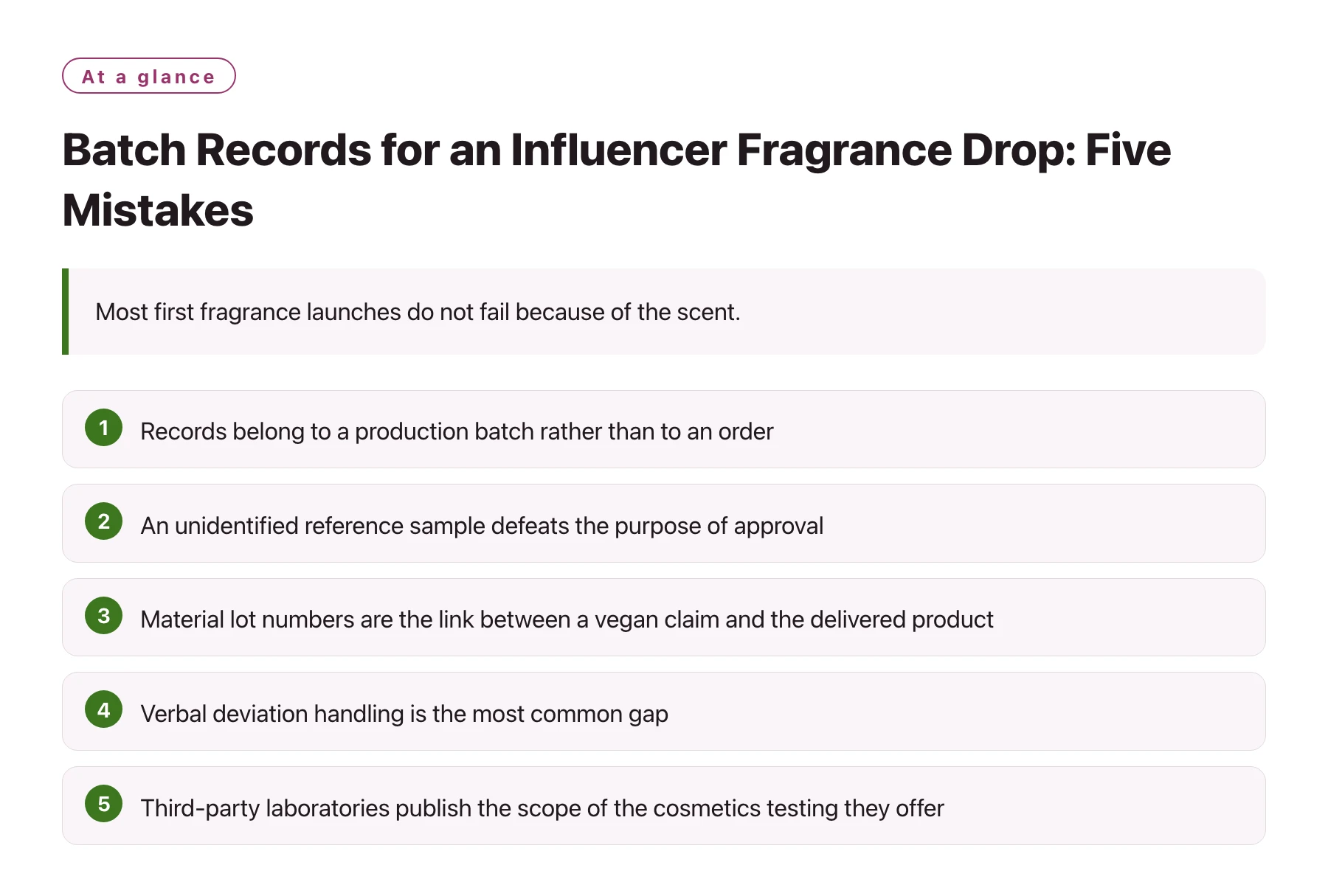
Key takeawaysRecords belong to a production batch rather than to an order, because an order can be filled from more than one batch and the difference matters when something goes wrong. · An unidentified reference sample defeats the purpose of approval, since a comparison needs an identified unit rather than a remembered one. · Material lot numbers are the link between a vegan claim and the delivered product, and without them the claim rests on the supplier's word. · Verbal deviation handling is the most common gap, because a substitution or a process adjustment that is not written down cannot be reviewed later. · Third-party laboratories publish the scope of the cosmetics testing they offer, which is a useful way to see which evidence can be commissioned rather than assumed [1].
An influencer launch usually compresses the front end of a project and leaves the back end untouched. The audience arrives quickly, orders are placed, and the brand is suddenly managing replacements, questions and occasionally a batch problem, all with the records it happened to keep.
This article lists five mistakes that appear repeatedly in first drops, what each one looks like in practice, and the control that prevents it. It is written for whoever ends up owning quality on a small brand, which is often the founder.
The five mistakes and the control for each
| Mistake | What it looks like in practice | The control that prevents it |
|---|---|---|
| Records filed by order, not by batch | A reorder is filled from a second batch, but the file still describes the first | A batch number on every unit, and a record set that uses that number as the key |
| Reference sample not identified or signed | Two bottles on a shelf, and disagreement about which one was approved | A countersigned approval sheet naming the sample code, the approver and the date |
| Material lot numbers not recorded | A vegan claim that depends on which lot was dispensed, with no way to check | Lot numbers captured at dispensing and carried through to the batch record |
| Deviations handled by message | A substitute material or a process adjustment agreed in chat and never filed | A written deviation note with the reason, the decision and the brand's response |
| No retention samples kept | A complaint cannot be compared against the batch that was actually shipped | Retained units per batch, stored under the same conditions as the delivered goods |
Each control is small on its own. Together they are the difference between a brand that can answer a question in an hour and one that has to ask the factory to reconstruct a project from emails.
Why the order is the wrong unit of record
Commercial documents are organised by order, because that is how money moves. Production documents are organised by batch, because that is how material moves. When a brand only keeps the commercial file, it inherits a structure that cannot answer production questions.
The gap becomes visible at the first reorder. A second order is filled from a new batch, using materials that may have come from different lots, on a line that may have run other products in between. If the record set is keyed to the order, the two runs are indistinguishable on paper even though they are physically different products.
The fix is cheap. Ask the supplier to print a batch number on the unit or the carton, and to issue the record set under that number. Then keep the records together as a single file, so a question about a specific bottle can be answered without asking anyone.
This is also the point where the brand decides what it will be able to prove. It is worth asking the same question of the company behind the fragrance museum that would be asked of any partner: which document, for which batch, shows what was made and from what.
The reference sample is evidence, not a keepsake
A reference sample without identity is a souvenir. For it to function as evidence it needs a code, a date, an approver and a stored location, and both parties need a unit from the same approval event.
The mistake usually appears in one of two forms. Either the sample is a hand-filled unit that never represented the production process, or the approval happened in a message and the physical sample was never labelled. Both make a later comparison meaningless, because there is no agreed baseline.
The control is a one-page approval record. It names the sample code, the dosage, the fill size, the pack components and the person approving, and it references the exclusion list version that applied. That single page resolves most disputes before they become disputes.
Where the brand has a vegan specification, the approval record should also state which material list was used. A later substitution then has a documented starting point rather than a claim about what was originally agreed.
Material lots and the vegan claim
A claim about ingredients is only as good as the material records behind it. If the brand asserts that no excluded material was used, the evidence is a set of lot numbers that can be traced to suppliers and specifications.
This is the mistake that costs the most to repair, because it cannot be reconstructed after the fact. Either the lot numbers were captured at dispensing or they were not. Asking for them at the briefing stage costs nothing; asking for them after a complaint is usually impossible.
It also interacts with testing. Where a claim depends on a test result, the tested unit should be traceable to the batch that was shipped. Third-party laboratories set out the scope of the cosmetics testing they offer, which helps a brand distinguish a standard panel from a project-specific study [1].
A practical rule for a small brand is to request the material declaration for the batch actually delivered, not a general declaration for the product. The general document describes what is normally used; the batch document describes what was used.
Deviations, retention samples and the archive
Deviations happen in every production run. A material arrives late, a filling tolerance drifts, a carton print needs correcting. None of these are necessarily problems, but an undocumented deviation is a hole in the record, and holes are what an auditor or a retailer will find first.
A written deviation note is a short document: what differed, why, who decided, and what the brand's response was. It takes minutes to write at the time and cannot be recreated honestly later.
Retention samples protect the same interest from the other direction. Keeping units from each batch allows a complaint to be compared against the actual production run rather than against a remembered ideal. The storage conditions should match the conditions the delivered goods experienced, or the comparison is not fair to either side.
The last mistake is an archive problem rather than a production one. Records that exist but cannot be retrieved are not records. Before the drop, agree who holds the file, in what format, and for how long. Understanding how safety testing in perfume manufacturing fits into the same file makes it obvious which documents belong together.
Where the brand wants to see how scent documentation is presented to the public rather than to a buyer, a visit to a fragrance museum in Guangzhou is not evidence about production, but it is a reminder that the story and the record have to describe the same product.
Before the drop ships, ask one question: if a customer sends back a bottle in six months, what will you open to find out what was in it? If the answer is an email thread, the record set is not finished.
Sources
- SGS: Cosmetics, Personal Care & Household Testing —— Testing, inspection and certification services for cosmetics and personal care, including microbiological, stability and safety testing aligned with cosmetics GMP.
Frequently asked questions
What counts as a batch record for a fragrance product?
The set that describes how a specific batch was made: the approved formula version, the material lots dispensed, the compounding and filling details, the test results, the release decision and the retained sample reference. It should be keyed to a batch number, not to a sales order.
Does a small brand really need retention samples?
Yes, and they are inexpensive. They allow a complaint to be investigated against the batch that was actually shipped. Without them, the brand can only compare the complaint against a description, which rarely settles anything.
How long should batch records be kept?
At least as long as the product is on the market plus a margin. The exact period depends on the market and the channel, but the useful principle is to keep the record for longer than the shelf life so a late complaint can still be investigated.
What should happen if a material is substituted during production?
It should generate a written deviation note stating what changed, why, who approved it and what the brand decided. On a vegan line the substitute also has to be checked against the exclusion list, and the batch record updated to reflect the material actually used.
Can the factory be asked to supply the full record set?
Yes, and it is better to agree the list before the order than to request documents after shipping. Some documents are generated routinely, while others need to be created during production, which is why the request belongs in the order terms.